Nightly Feelings
Both planned and unexpected trajectories in Berlin led me to write this text at the end of summer, when nights were short and heatwaves were burning skin and the city. Exhibitions, dance floors, films and people come together in dialogue about how darkness can reshape our sensibilities.
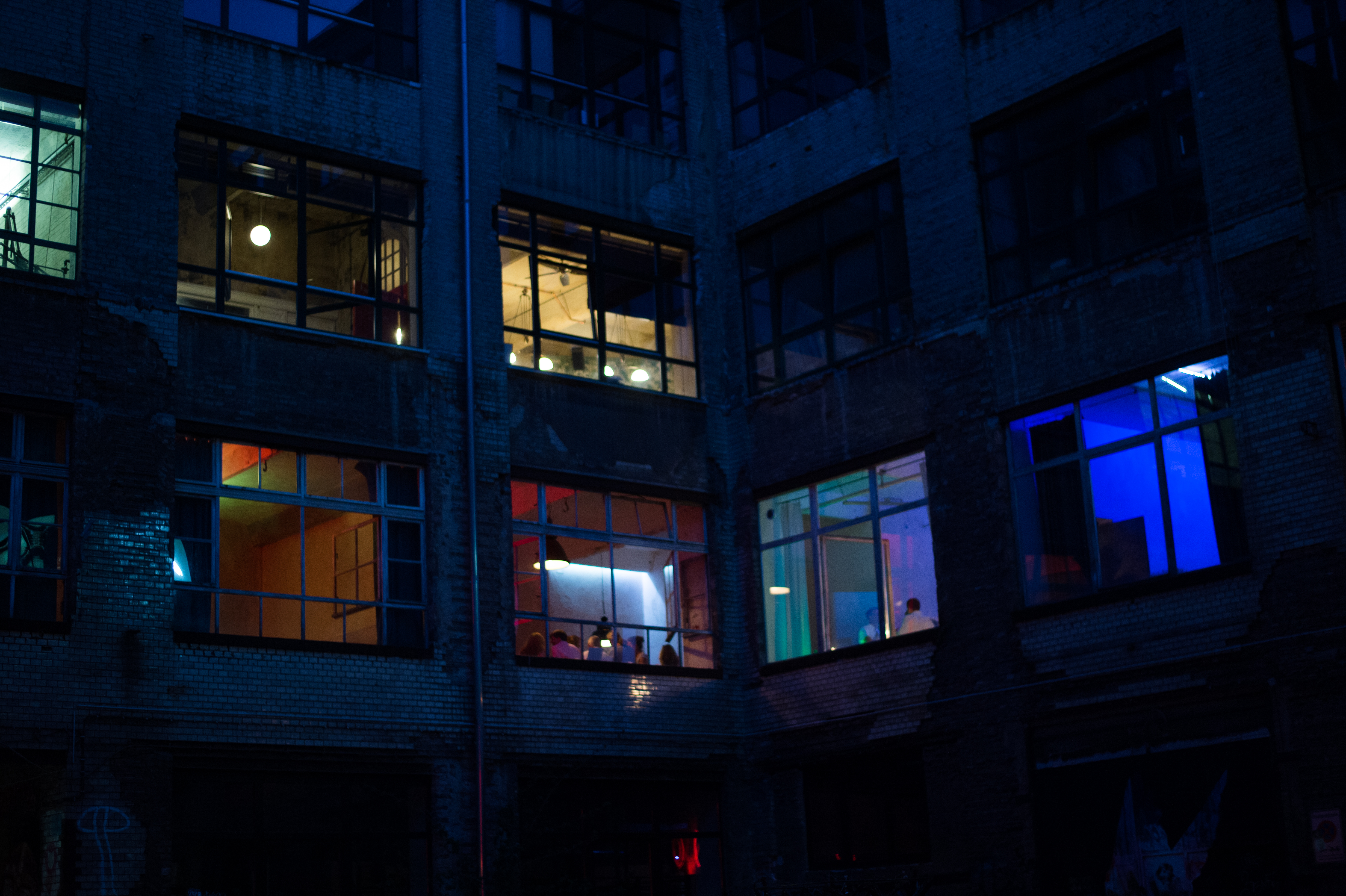
One very late summer evening the power went out in my flat in Berlin. Lying in bed in the dark, I didn’t notice. Only in the bathroom did the situation become clear. For a moment my eyes tried to adjust. The thought of being blind crossed my mind, as instead of seeing distances and objects, my body was trying to feel them. The space is tiny. My mind tried to remember the way by touching the surfaces. The whole building was dark. Most of the street was dark. The sweet workers of the neighbourhood restaurants were at a loss. The police were trying to figure something out. The night was there and it wanted to stay.
Which nightly feelings should I let linger? Which ones should I overcome?
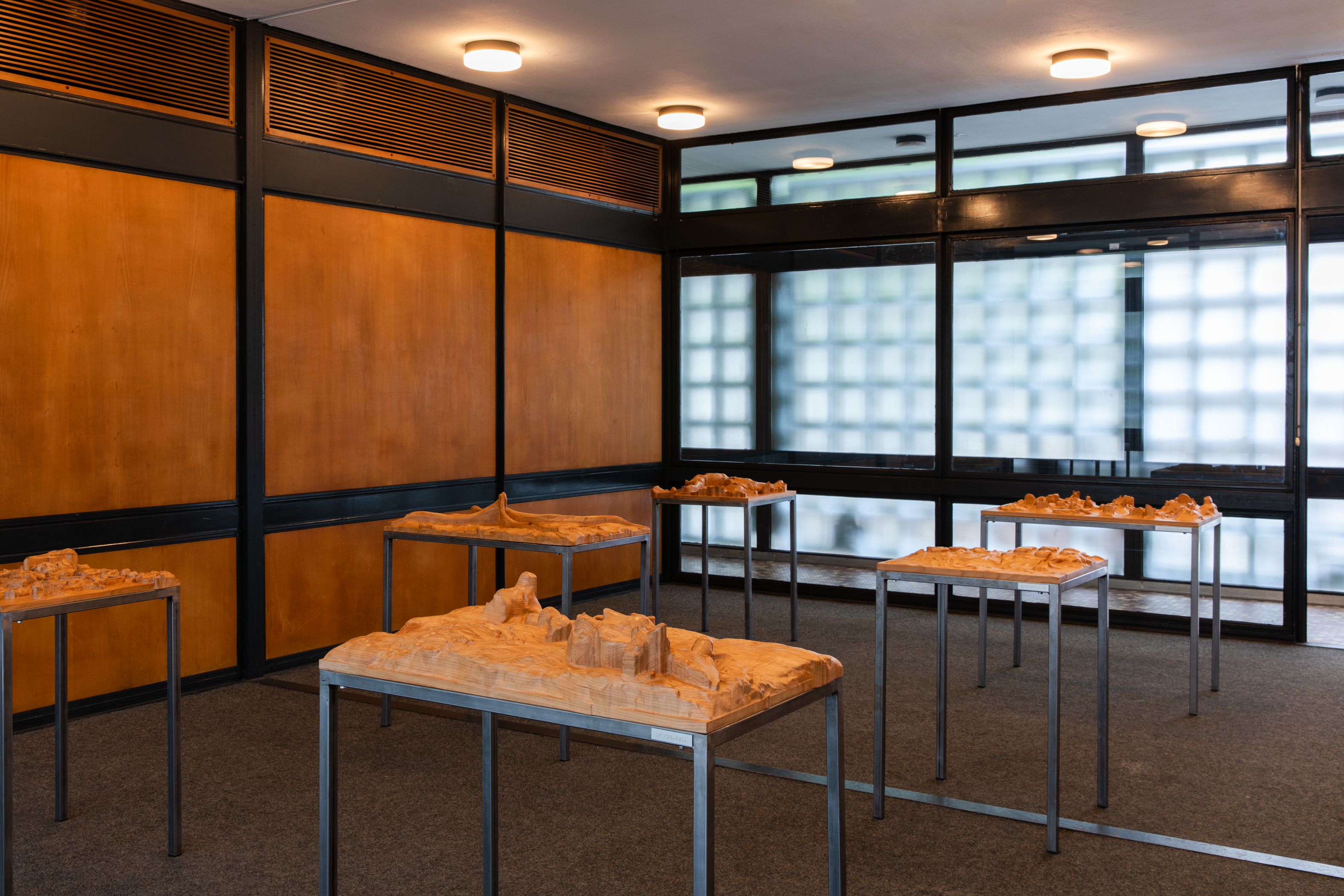
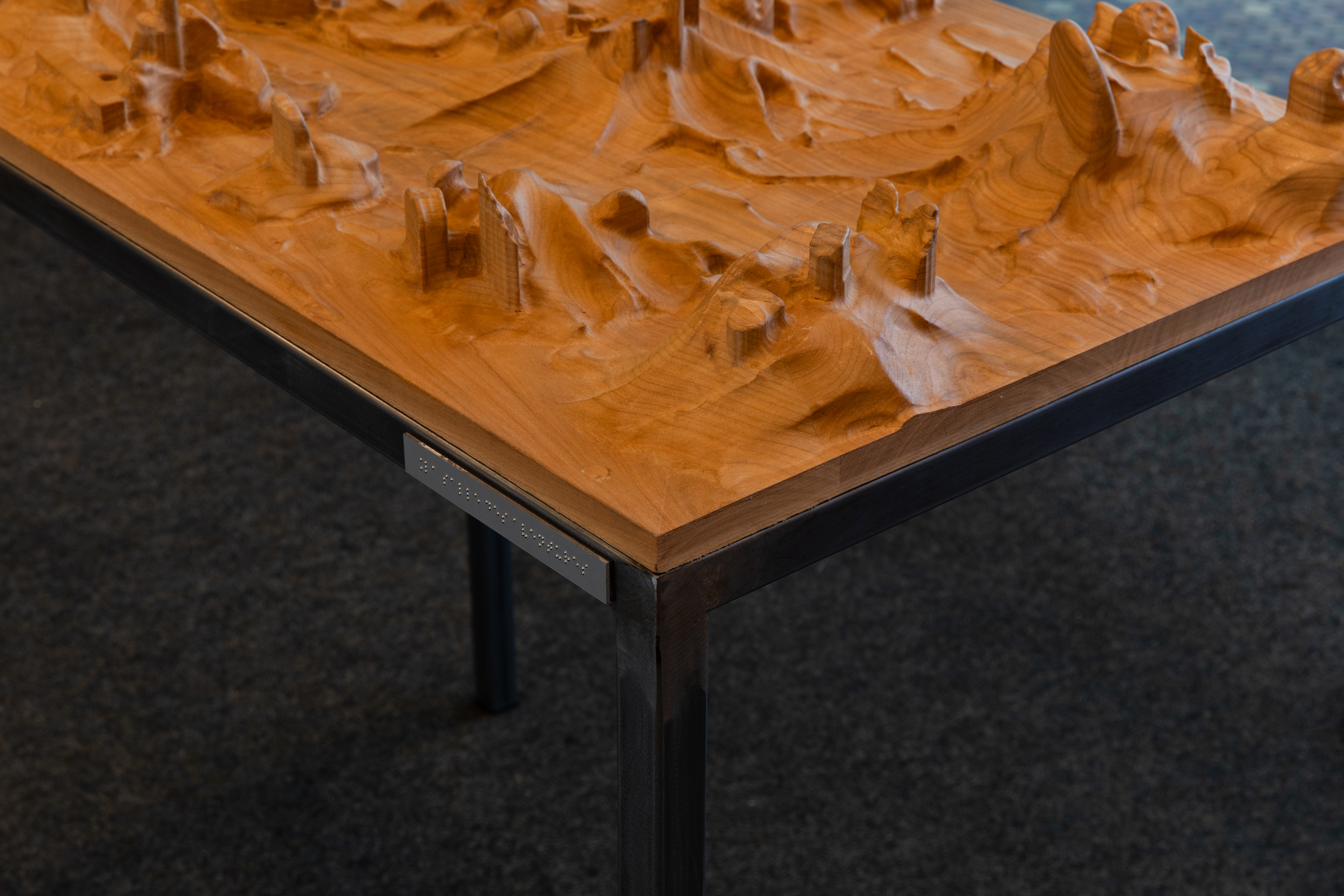
By a weird and inspiring coincidence, the next day I went to see Éric Baudelaire’s exhibition When Night Falls at CCA Berlin (12 June – 29 August 2026). In small rooms on the ground floor there was a series of wooden sculptures, Clair de lune (Moonlight, 2026), that the artist made together with the students of the National Institute for Blind Youth in Paris. Visitors were encouraged to touch the artworks and feel their pleasantly polished surfaces. The titles next to the sculptures were written only in braille. For people who cannot read braille, there were paper brochures at the entrance with a map and titles of the artworks. I touched these strangely warm sculptures and tried to understand the connection between what I saw and the titles I read. Only later did it cross my mind that I should probably rely on my hands and the feeling, instead of connecting the titles with what I saw.
Downstairs, a five-channel video installation of the same title – almost an hour and a half long – moves between seven locations, from Europe’s largest rose farm in Spain to the UNESCO General Assembly, from a French National Metrology and Testing Laboratory to the National Institute for Blind Youth in Paris, and few others. Claire Atherton’s precise editing across the five screens kept my mind unusually sharp.
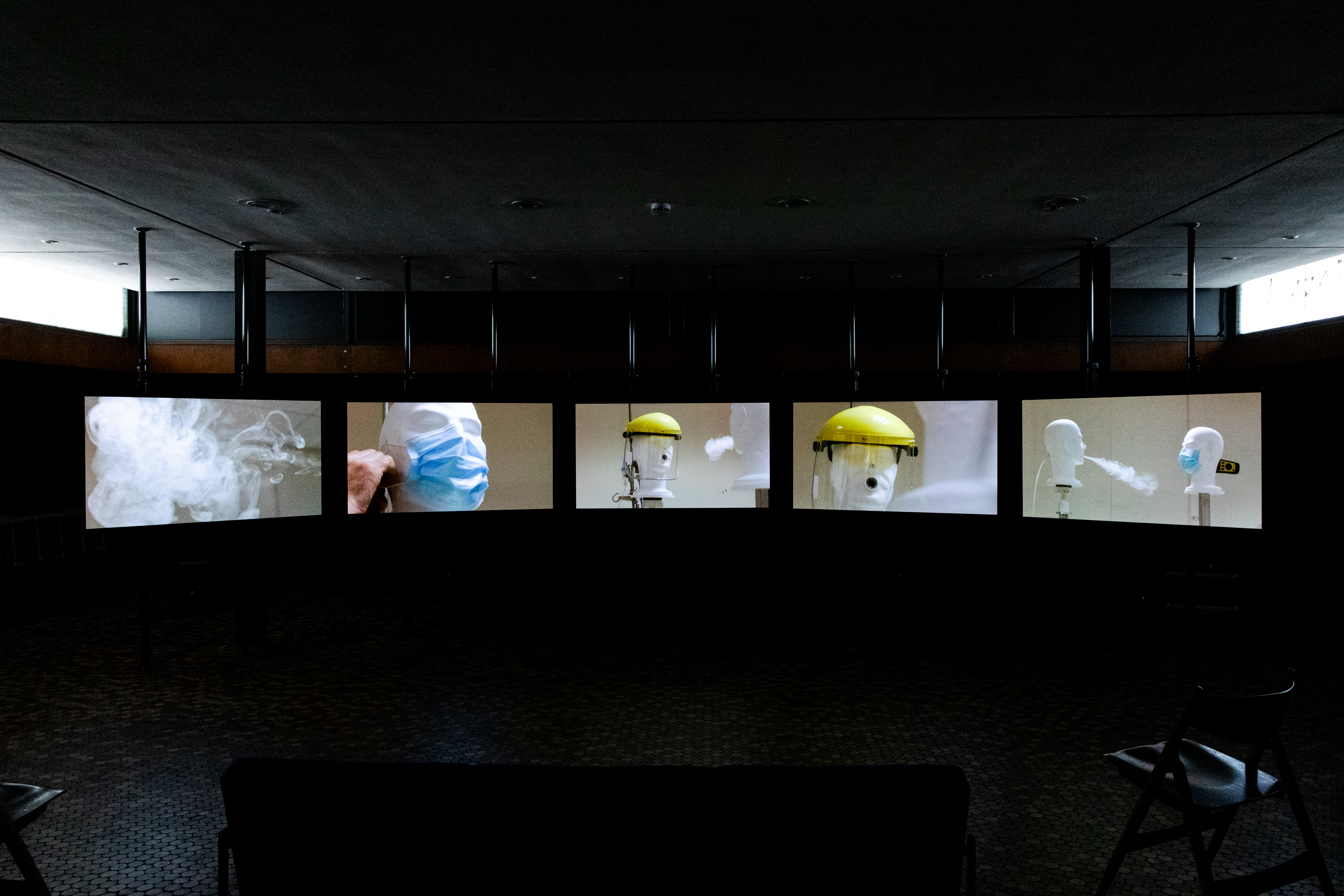
This sharpness had already been awakened by a few lines by Roland Barthes, quoted in the introductory text to the exhibition: “To be strangers to one another is inevitable, even necessary and desirable – except when night falls”. I was very moved by this thought. Watching details in close-ups and mid-shots, all filmed by Claire Mathon with a handheld camera, I was immersed in trying to get to know what I saw. Some screens go black and different details appear afterwards. My eyes jumped from one to another, sometimes catching two screens showing identical shots at the same time. People work, research, play, connect, learn. All these activities take place in different contexts – from cutting and packing roses in the farm to measuring signals to forecast the weather.
Perhaps the most striking and touching part was the scenes at the school for blind children. I kept thinking about how Barthes’s phrase speaks to them. Observing how they learn to peel a cucumber or to measure how much water they pour into a glass. How much time these small everyday actions take, and how much sensitivity they require of your hands. How they touch each other while going on walks, holding each other’s shoulders, staying close. One scene stayed with me in particular – a boy and a girl sitting on a bench, searching for something on a phone, chatting. At the end of the scene, they stand up, holding on to each other, and the girl says: “I’m so tired of carrying things. I always need to carry so much.”
Éric Baudelaire approaches nightfall with a strong will to keep seeing the light. If some parts of the film question people’s actions, others balance them out. He focuses on people staying together, holding on to each other through research, through learning, through work that preserves the past or foresees the future. Like the light bulbs that switch on and rotate in the Metrology and Testing Laboratory, the film gives hope that sometimes you need the darkness of the night to see the light.
When I left the exhibition and the heatwave in Berlin hit my body again, I kept thinking about how beautiful and sensitive the scenes with the young blind people were. Somehow, watching them, the darkness of the night was the last thing on my mind. I began to regret every time I had used the word ‘blindness’ to describe someone or something in a negative sense. It is so common to blame someone for not seeing things or situations clearly. People who behave immorally, government structures that don’t work, politicians and leaders who don’t realise when their actions and words go wrong. They are not blind; they are just wrong, and in many cases they are incapable of sensing their surroundings and other people the way some blind people can and do. It’s this intuitive feeling that you train day by day all your life to become a slightly better person, a little wiser. And when language limits this feeling to the metaphors of seeing, somehow it all starts to glitch and flicker when the night falls, as if to awaken different senses. But perhaps we should turn to that deepest feeling that calls us to wait a bit, adjust our eyes, learn to reorient ourselves and face the darkness wisely.
The nightly feeling of summer in Berlin comes into focus from different directions. A friend once told me that she feels uneasy around people who are afraid to meet their shadows. I told her that, for me, dark dance floors and long sober hours of dancing to hypnotic techno are sometimes a face-to-face meeting with my own shadows. Those dancing experiences in Berlin can happen even on Sunday afternoons. It makes no difference when: in a dark space, as the shades of light shift, your gaze meets another’s – and when that meeting is accompanied by a smile, the feelings of the night bring you together. Sometimes there’s no need to speak; you can meet on the dance floor and not remain strangers. Other times, introspection takes over, and you journey along with the music, eyes closed, yet respecting the other bodies dancing beside you, rejoicing that you can dance out so much together with others and your own shadow is no longer a stranger to you.
Deceiving through the gift, deceiving through an imitation of peace, is not wise – it’s only clever
But there’s another side to this, where once again it doesn’t matter whether it’s morning or evening: people passing by in the city, lost in their own thoughts, evoke nightly feelings that hold no light within them. Disoriented, lost, bodies without refuge. And I realise that I can’t seem to overcome the feeling of alienation. I don’t know if I’d be able to strike up a conversation when, more often than not, they’re already talking out loud so intensely to themselves.
I wonder why Odysseus didn’t speak to the Cyclops after all. One of the most heart-wrenching scenes for me in Christopher Nolan’s film The Odyssey was precisely the one in Cyclops’s cave. Nolan’s take on the Odyssey is so relevant today and the darkness of the whole film relates exactly to this feeling that we are living in a time of shortened days; night is taking over. It is already a cliché to say that we live in dark times, but Nolan tries to go back to one of the most important myths of Western culture and offer his interpretation of what has become so broken in our culture. Deceiving through the gift, deceiving through an imitation of peace, is not wise – it’s only clever. That’s how Odysseus behaves in almost all of his encounters on the way home. Especially with the Cyclops – he blinds him and causes so much pain, then realises he could have tried to talk with him, and admits that it is too late. It’s been a while since I saw such a strong effort to understand suffering and its roots in a blockbuster film. This darkness that Nolan portrays in The Odyssey is painful. Betrayal is very painful and makes the night fall faster.
In his review, film critic Dmitrij Gluščevskij asked where the warm colours and bright landscapes of Greece were. Only when Odysseus stays with Calypso are we showered with the sunlit brightness, which is associated with oblivion. I found that decision quite obvious but also straight to the point. It can be bright and warm when you are escaping your memories, the cruelty of your own actions and those of others. But if you’re used to seeing only in the dark, too much light can dazzle you, leaving only outlines and erasing important details. So how do I strike that balance? Which nightly feelings should I let linger? Which ones should I overcome? And which ones should ultimately prompt a conversation – or at least acceptance?
Lina Lapelytė’s installation We Make Years Out of Hours at Hamburger Bahnhof may offer some answers, as it creates a space for encounter. We are greeted by the museum’s bright Historic Hall, where countless identical wooden blocks are stacked into piles that can be freely rearranged. Stepping onto a floor covered with these same blocks, we immediately find ourselves in a play area. Here, visitors can build castles, walls and mazes, and then tear them down themselves, leaving the blocks without any set structure – simply scattered haphazardly – until the next person comes along and uses their imagination to transform the previous creation.
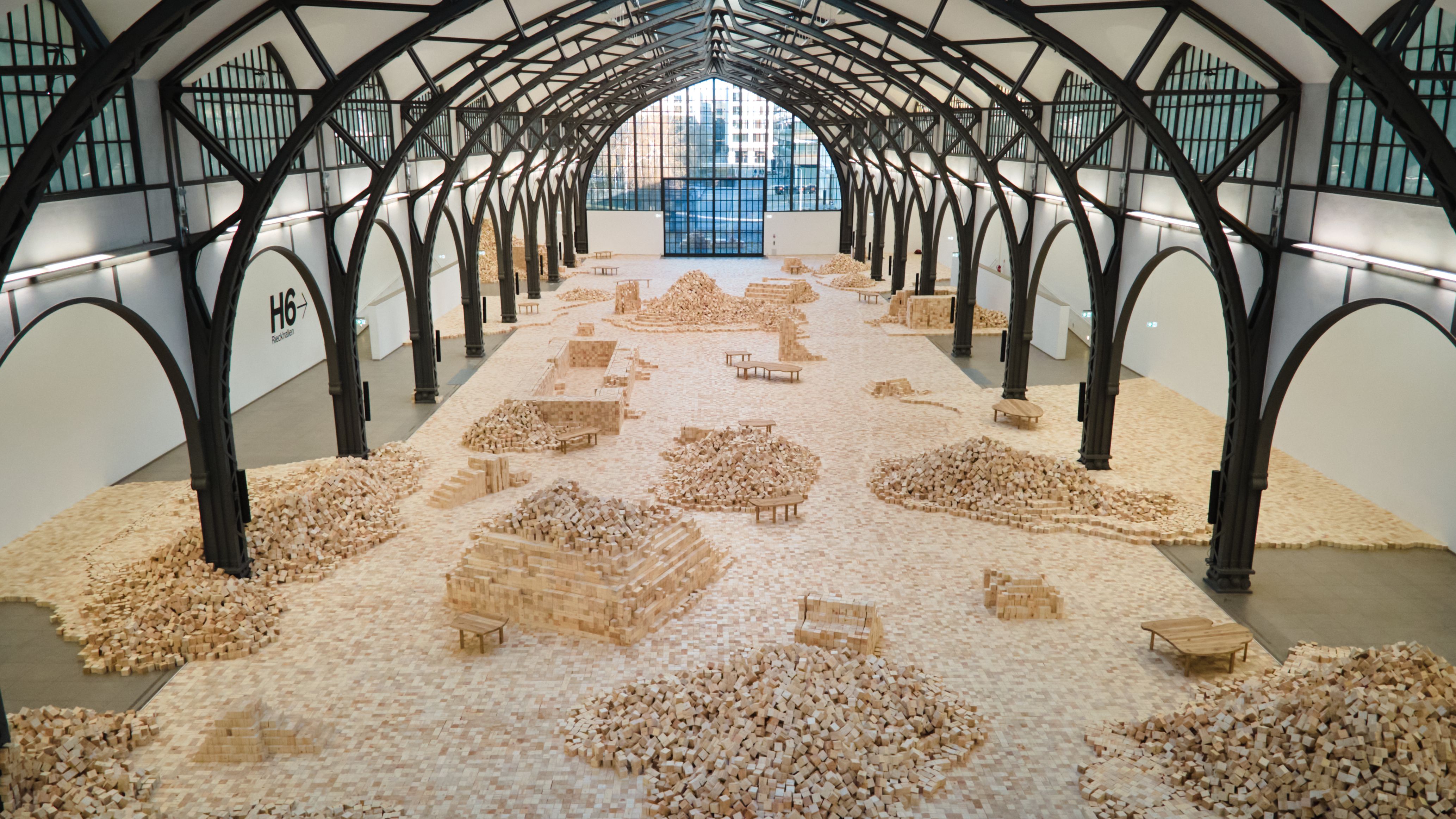
I’d also like to return to Éric Baudelaire, as both of these artists highlight togetherness as a key – perhaps a recipe, or simply a gentle invitation – to making the feelings of the night more bearable, or even as bright as possible. While the media constantly discusses our ever-increasing dependence on smartphones and social media – and the threats this poses to young people – at Lapelytė’s exhibition, it was mostly adults who were filming and taking photos, whereas the children were playing with the small wooden blocks, as focused as children at play can be. That was such a hopeful experience. Every time I returned to the installation, I felt the joy of seeing people so completely engaged.
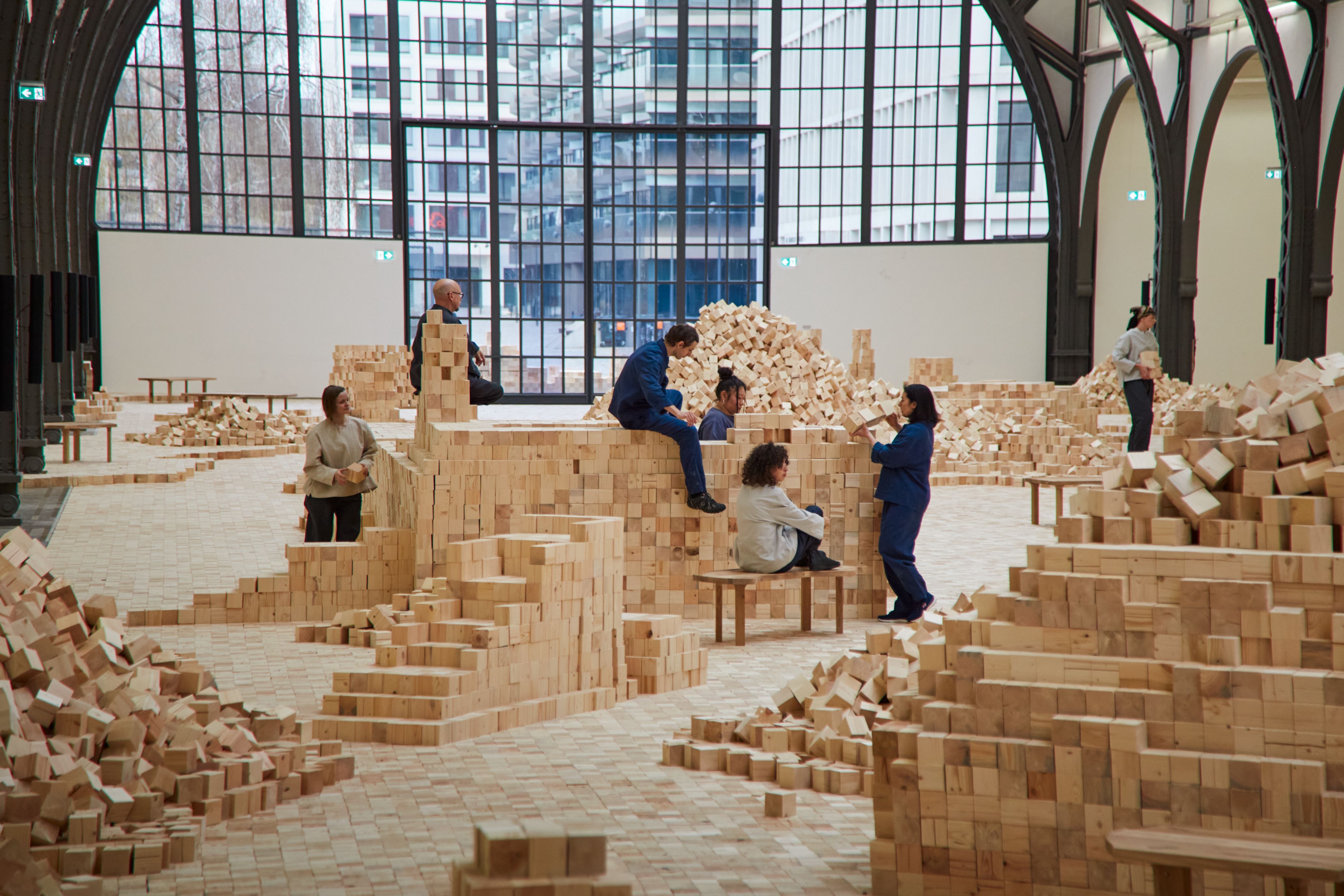
But the work reveals itself fully when this play and presence among the multitude of wooden blocks is accompanied by a musical composition. The singers do not stand out from the audience, but fill the space with their gentle voices. The quotes Lapelytė chose for the singers are both delicate and sharp, while the music that carries the voices is so soothing. I read the entire libretto several times, and some of the words kept spinning in my head – especially these:
Hey C’mon
Come out
Wherever you are
we need to have this meeting
at this tree
ain’ even been
planted
yet
(From June Jordan, ‘Calling on All Silent Minorities’, in Directed by Desire: The Collected Poems of June Jordan (Port Townsend, WA: Copper Canyon Press, 2005).)
I was left with the impression that something utopian was happening in that huge hall, where trains once arrived and departed. But it was real – a well considered artwork that brought people together, to build something, to listen, to read, to play, to experience time fully.

The summer ended and the short, hot nights grew longer. The night’s association with adventure and unexpected encounters turned into longer periods of silence and hope for snow to make it brighter. There are many different ways to experience the fall of the night. Darkness can be precious, as well as cruel. Nightly feelings can be helpful or destructive. At times the answer is very clear, but it can also be too subtle to grasp, or take much longer to feel. The South Korean writer Han Kang teaches courage and, in the most subtle way, stops me from running away from darkness. The chapter ‘A Conversation in Darkness’ in her book Greek Lessons somehow brought the theme of reorienting oneself to a close, of adjusting to something you are not used to. It felt like proof that a meeting can happen in the strangest, most unexpected ways, and that there are so many ways to stop being strangers when night falls. You can lose sight, you can lose language, but nightly feelings sometimes bring you together to endure what has happened to you.
Night,
having opened our eyes to see
the tree’s soul and the bird’s dream –
Night,
having fettered our feet
with the darkness of grass,
with fatigue and premonition –
Night,
having filled our cupped hands
with midsummer’s heat
and a thirst for tenderness –
Night,
giver of rest and peace –
under your ineffable
darkness of apprehension and unknowing,
having taken over the world –
may you embrace
our naked unease.
(Janina Degutytė, ‘Naktie…’, translated by Rimas Uzgiris. Original in Nemeilės šešėly (Vilnius: Lietuvių literatūros ir tautosakos institutas, 2025), p. 174.)
Mantė Valiūnaitė is a film curator, scholar and critic. In 2024, she successfully defended her PhD thesis in art history, entitled ‘Hybridity in Cinema: Theoretical Concepts, Film Festivals and Case Studies of Lithuanian Documentary Films’. Together with her colleagues Aistė Račaitytė and Ignė Smilingytė, she founded the film production company Taip toliau. Mantė was the artistic director of the Vilnius International Film Festival Kino pavasaris; she also worked as a programmer at the international human rights documentary film festival Nepatogus kinas and curated various projects at the non-governmental organisation Meno avilys. She currently works as a programme curator at the Vilnius Short Film Festival, teaches at the National Film School (LMTA), and writes film reviews for the cultural weekly 7 meno dienos and LRT.lt.