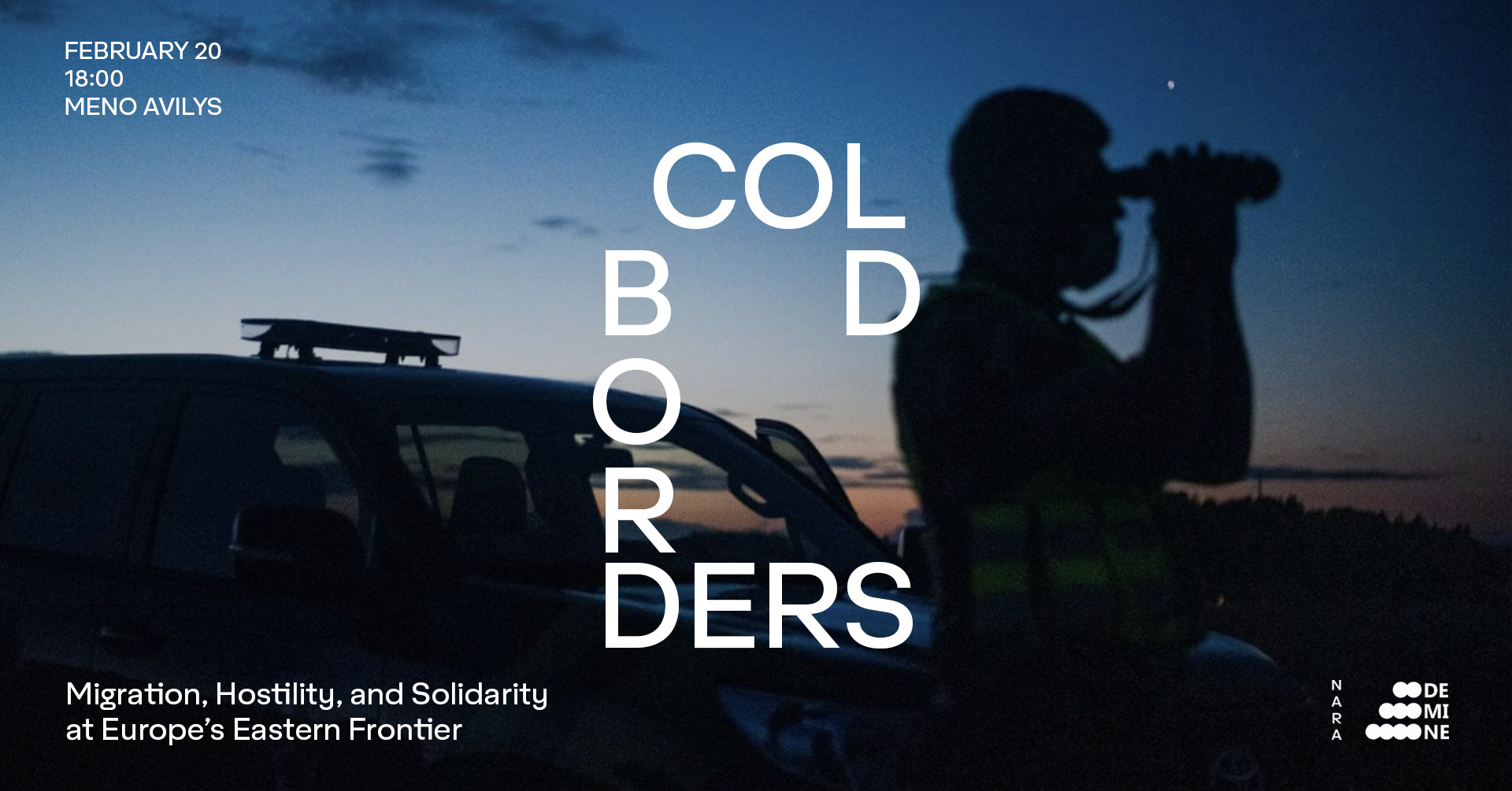
When? Friday, 20 February, 18:00
Where? Meno Avilys (Goštauto g. 2, Vilnius)
This event brings together journalism, academic research, and activism to reflect on the Lithuanian–Belarusian border crisis.
It features:
– Benjamin Nangle (KU Leuven) presenting his co-authored book The Construction of Hostility Towards Migrants.
– Julija Kekstaite (Ghent University / Sienos Grupė) presenting research from her PhD thesis Filling Gaps and Making Cracks: Humanitarian and Solidarity Practices with Illegalised Migrants in Lithuania’s Borderlands.
– Francesco Rufini and Indrė Kiršaitė (NARA) presenting their short video documentary Border Limits.
The event will conclude with a panel discussion and Q&A. It will be recorded and shared online.
Benjamin Nangle is a researcher at KU Leuven specialising in far-right propaganda and anti-migrant discourses in Europe, with extensive experience in humanitarian asylum seeker response and advocacy. During the 2021 Lithuanian–Belarusian border crisis, he volunteered with the Red Cross in migrant detention centres. Drawing on his co-authored book with Giedrė Blažytė, The Construction of Hostility Towards Migrants, this presentation examines the historical, political, propagandistic, and geopolitical forces that shaped Lithuania’s response to the crisis. From neo-Nazis to neoliberal think tanks, from fearmongering journalists to EU politicians, he explores how anti-migrant hostility was constructed and normalised in public discourse.
Julija Kekstaite is a researcher at the University of Ghent and a member of Sienos Grupė, involved in a humanitarian response to the 2021 border crisis. Her presentation draws on her PhD thesis, Filling Gaps and Making Cracks: Humanitarian and Solidarity Practices with Illegalised Migrants in Lithuania’s Borderlands. Focusing on the grassroots initiative Sienos Grupė, she examines how ordinary people mobilised to support migrants after 2021, when arrivals from Africa and the Middle East were met with intensified border controls and state violence. Based on her dual role as member and researcher, she explores how everyday acts of care, providing aid, documenting violence, and advocating for rights, both respond to and expose a border regime that renders some lives disposable. The talk considers what such activism reveals about contemporary border governance and how collective care can challenge dominant narratives and reimagine political responsibility and community.
The NARA short video documentary Border Limits by a journalist Indrė Kiršaitė and a filmmaker Francesco Rufini explores life in Katra, a small village in southern Lithuania on the border with Belarus. Once home to 130 residents, today only four Belarusian widows remain. They moved here decades ago after marrying local men, crossing a border that lay barely ten kilometers away. Now they witness how people from thousands of kilometers away try to enter Lithuania, and for some the journey ends in death.
The event is co-organised and co-funded by the DEMINE European Joint Doctorate network, supported by the European Union’s Horizon Europe programme under the Marie Skłodowska-Curie Actions Doctoral Networks.